Exploring AI-Generated Digital Twins: A New Frontier in Simulation
Acutus Ai
February 10, 2026
Reading Time: null

Unpack the transformative power of AI-generated digital twins and how they're revolutionizing real-world simulations in healthcare, smart cities, and engineering, enhancing accuracy, decision-making, and predictive outcomes.
Digital Twins in UX Research: Simulating Human Behavior with Generative AI
User research is powerful but it’s slow. Recruiting participants, running studies, analyzing responses, and waiting for insights often stretch timelines and budgets. As generative AI rapidly evolves, one big question keeps surfacing across research disciplines:
Can AI make research faster, more scalable, and more adaptive?
Among the many emerging ideas, one of the most promising and controversial is the concept of digital twins: AI models designed to simulate real human behavior.
This article explores what digital twins are, how they differ from synthetic users, where they can be applied, how they’re built, how well they actually work, and why ethics must remain front and center.
What Is a Digital Twin?
A digital twin is a generative AI model usually powered by a large language model (LLM) designed to act as a stand-in for a specific individual.
Think of it as a cognitive proxy: a system that attempts to respond to questions, scenarios, or decisions in the same way a real person would. These models are created using personal context such as demographics, survey responses, interview data, and behavioral histories.
Once created, a digital twin can be used to:
- Predict how a specific individual might behave
- Simulate responses across a group by aggregating multiple twins
In practice, this means a digital twin could answer survey questions, anticipate reactions to design changes, or simulate decision-making without repeatedly involving the actual person.
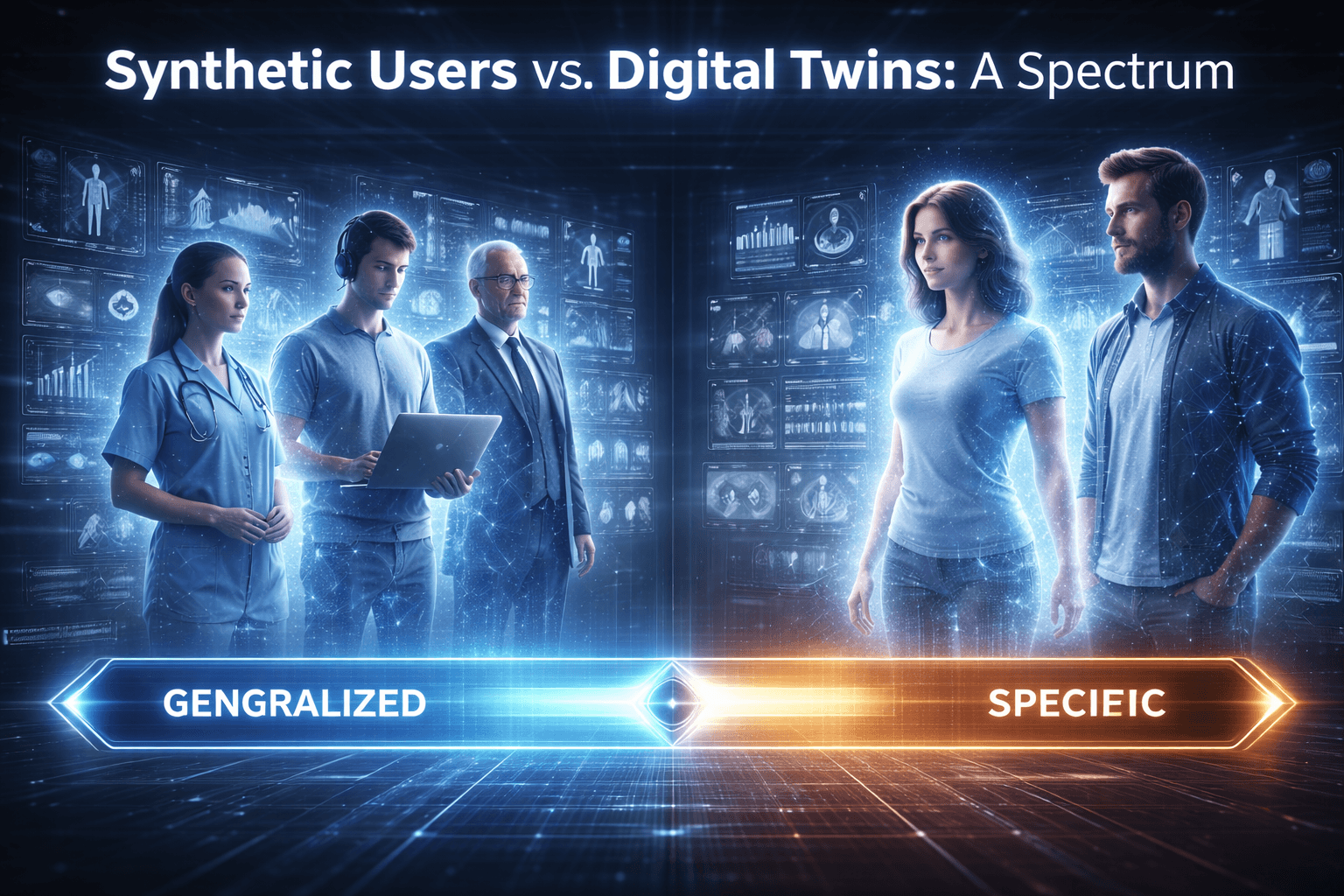
Synthetic Users vs. Digital Twins: A Spectrum
AI-based human simulation typically falls into two categories:
Synthetic Users
Synthetic users represent groups or segments rather than individuals. They’re generated from generalized descriptors like demographics, roles, or shared characteristics for example, “healthcare professionals in Latin America.” These models are best suited for predicting population-level trends.
Digital Twins
Digital twins focus on specific individuals, using rich, personal data to model how one person thinks, feels, and acts. These models can be used to predict both individual and group behavior.
In reality, the distinction isn’t black and white it’s a continuum.
- On one end: models built from broad, shared attributes (highly generic)
- On the other: models grounded in deep, individual-level data (highly specific)
As the amount of personal information decreases, a digital twin starts behaving more like a synthetic user. The more detailed the data, the more closely the model mirrors a real individual.
Where Digital Twins Can Be Used
Predicting Individual Preferences and Behavior
Digital twins open up new possibilities in UX, behavioral science, and marketing, including:
- Filling in missing survey data by predicting skipped responses
- Shortening surveys by asking fewer questions and inferring the rest
- Representing hard-to-reach users, especially when repeated recruitment is impractical
- Journey prediction, anticipating how users will respond at different touchpoints
- Early usability detection, surfacing potential friction or emotional reactions before launch
Simulating Population-Level Outcomes
Although digital twins are built at the individual level, their outputs can be aggregated to simulate how larger audiences might respond to new designs, features, or messages.
By weighting digital twins to reflect real population structures, researchers can approximate representative samples allowing large-scale testing before any real-world rollout.
How Digital Twins Are Created
The quality of a digital twin depends on both the data available and how that data is integrated into the model.
Common Data Inputs
- Demographics
- Stated preferences and beliefs
- Persona-style summaries
- Survey histories
- Interview transcripts
- Behavioral data (browsing history, purchase behavior, usage logs)
Methods for Building Digital Twins
1. Prompt Augmentation
The simplest approach: injecting personal context directly into the AI prompt. While easy to implement, this method struggles with large data volumes due to prompt-length limits.
2. Retrieval-Augmented Generation (RAG)
Here, personal data is stored externally (e.g., interviews, logs, documents). When a prompt is submitted, the most relevant information is retrieved and appended dynamically.
This approach enables richer context without overwhelming the model.
3. Fine-Tuning
The most advanced and expensive option involves retraining the model on domain-specific data. This allows the AI to internalize patterns across many similar users.
For example, if many dog owners in the training data prefer fenced yards, the model may infer the same preference for a specific dog owner—even if that preference wasn’t explicitly stated.
Do Digital Twins Actually Work?
So far, simulated users haven’t fully captured the complexity and unpredictability of real human behavior. In our experience, they’re most effective as desk research tools, not replacements for real users.
However, digital twins show more promise than generic synthetic users because they’re grounded in the nuanced data of real individuals rather than averaged group traits.
Emerging research suggests that digital twins can be surprisingly effective in practical tasks such as predicting survey responses or filling in missing data especially when built from rich interview and behavioral datasets.
They’re not perfect, but they’re improving fast.
The Ethical Challenges
Digital twins raise serious ethical concerns that cannot be ignored.
- Consent: Did participants agree to have long-lasting AI proxies created from their data?
- Misrepresentation: What happens when a twin is used outside its original context?
- Bias amplification: How do we prevent historical data biases from being reinforced?
- Privacy and transparency: Who controls the twin, and how is it used?
These questions are no longer theoretical. As digital twins move toward real-world deployment, researchers and designers must take responsibility for ensuring ethical use.
Final Thoughts
Digital twins won’t replace traditional user research but they can meaningfully extend it.
When used thoughtfully, they offer a faster, more scalable way to explore hypotheses, predict behavior, and test ideas early. But their power comes with responsibility.
If the UX community approaches digital twins with transparency, caution, and ethical rigor, they could become a valuable complement to human-centered research helping teams move faster without losing sight of the people they’re designing for.
Frequently Asked Questions (FAQs)
1. What is a digital twin in UX research?
A digital twin in UX research is a generative AI model designed to simulate the behavior, preferences, and decision-making patterns of a specific individual. Built using personal data such as survey responses, interviews, and behavioral history, it acts as a cognitive proxy to predict how that person might respond in various scenarios.
2. How are digital twins different from synthetic users?
Synthetic users represent generalized audience segments (e.g., “urban millennials” or “healthcare professionals”). Digital twins, on the other hand, model specific individuals using detailed personal data. Synthetic users focus on population-level trends, while digital twins aim to simulate individual-level behavior.
3. Can digital twins replace real user research?
No. Digital twins are best viewed as complementary tools rather than replacements. While they can accelerate hypothesis testing and simulate early-stage feedback, they cannot fully capture the emotional complexity, unpredictability, and contextual nuances of real human behavior.
4. How are digital twins built?
Digital twins are typically built using one or more of the following methods:
- Prompt Augmentation: Adding personal context directly into prompts.
- Retrieval-Augmented Generation (RAG): Dynamically retrieving relevant personal data when generating responses.
- Fine-Tuning: Training models on domain-specific datasets to internalize behavioral patterns.
The quality of the twin depends heavily on the richness and accuracy of the input data.
5. What types of data are used to create digital twins?
Common data sources include:
- Demographics
- Survey responses
- Interview transcripts
- Behavioral logs
- Persona summaries
- Purchase and browsing history
The more granular and context-rich the data, the more realistic the twin becomes.
6. Where can digital twins be applied in UX research?
Digital twins can support:
- Predicting survey responses
- Filling in missing data
- Testing early design concepts
- Simulating user journeys
- Identifying usability friction
- Modeling audience-level outcomes through aggregated twins
They are particularly useful in early-stage product validation.
7. Are digital twins accurate?
Digital twins are improving but are not perfect. They perform best in structured prediction tasks (e.g., survey simulation or preference estimation). However, they still struggle with spontaneous emotional reactions and complex real-world decision-making.
8. What are the ethical risks of using digital twins?
Key concerns include:
- Lack of informed consent
- Misrepresentation of individuals
- Bias amplification
- Data privacy violations
- Misuse outside intended contexts
Ethical frameworks must guide their development and deployment.
9. Can digital twins simulate entire populations?
Yes, when multiple individual twins are aggregated and weighted to reflect real population structures, they can approximate large-scale outcomes. However, representativeness depends on data diversity and model training quality.
10. What is the future of digital twins in UX research?
Digital twins are likely to become a powerful augmentation tool for research teams. As generative AI improves, they may enable faster hypothesis testing, iterative design validation, and scalable behavioral modeling provided ethical safeguards remain central